New AHOP policy brief examines health workforce migration in Africa; demonstrates how collaborative strategies, such as bilateral agreements, can help manage brain drain
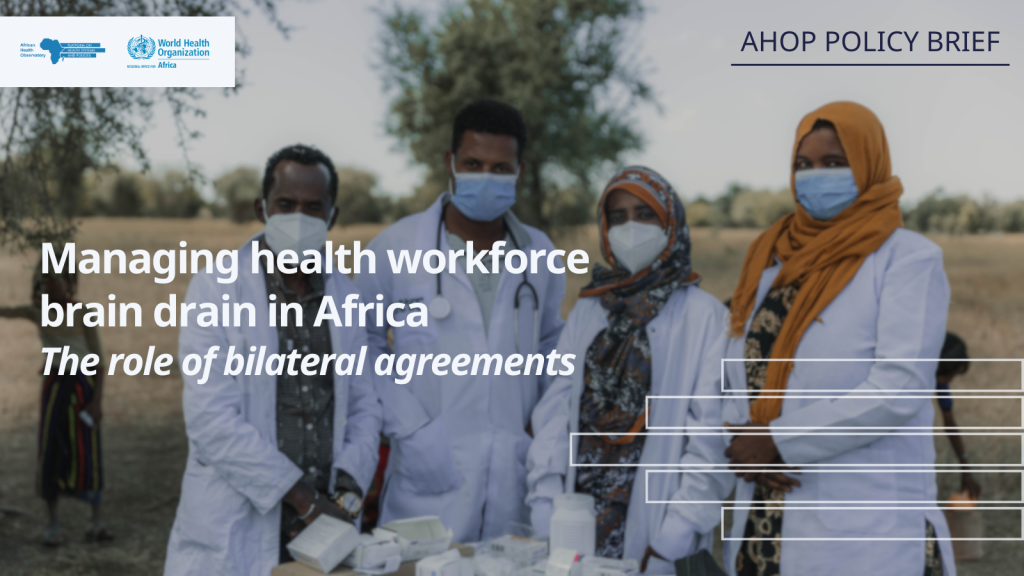
The African Health Observatory – Platform on Health Systems and Policies (AHOP) has published a new policy brief, ‘Managing health workforce brain drain in Africa.’ It examines health workforce (HWF) migration in Africa by integrating local and global evidence on bilateral agreements.
Large-scale emigration of African health workers is driven by factors such as inadequate remuneration, poor working conditions, political instability, corruption, underinvestment in HWF education, limited career progression opportunities and insufficient management support.
Health worker migration in Africa exacerbates existing shortages, leading to understaffed facilities and reduced access to care, particularly in rural areas. This contributes to lower quality of care, widening health inequalities and increased financial strain on source countries. Additionally, emigration disrupts continuity of care during emergencies and deprives health systems of valuable skills, thereby hampering health care delivery and slowing economic development efforts.
Africa is expected to bear half of the anticipated global HWF shortage by 2030.
Over the past 15 years, the WHO Global Code of Practice on the International Recruitment of Health Personnel (the Code), a voluntary international framework, has sought to address these challenges. The Code promotes ethical and equitable recruitment practices through government-to-government bilateral agreements that aim to yield mutual benefits.
This brief explores the potential of such agreements in managing HWF migration alongside other measures to counter staffing shortages. It showcases successful models tailored to the specific needs of African countries and highlights both the shortcomings and lessons learnt along the way.
AHOP is a regional partnership that promotes evidence-informed policy-making. It is hosted by the WHO Regional Office for Africa (WHO AFRO) and is a network of centres of excellence from across the region, leveraging existing national and regional collaborations.
The extended summary is now available for download in English and French. The entire policy brief will be published online soon.